Notes
FEEDING YOUR STARTER
Feed once a week if storing in the fridge, feed once a day if storing on the counter. If you go a few weeks or months without feeding it in the fridge, don’t worry. It will bounce back, mine has many times.
1 part starter
2 part bread flour
2 part water
Example:
30g starter
60g bread flour
60g water
MEASUREMENTS + EQUIPMENT
Ingredients for 1 loaf
500g bread flou
378g warm filtered water (you can use less water for a less “hydrated” dough, which is good for beginners. Maybe 350g)
100g sourdough starter
10g salt
Additional equipment
Proofing basket + liner
Kitchen scale
Rice flour
Scoring blade
Dutch oven
Dough scraper
Parchment paper
DAY 1 - Feed your fridge starter
Remove sourdough starter from fridge and feed. I feed in smaller ratios before I’m actually ready to use it in order to not waste starter and ingredients. Store on the counter overnight.
30g starter
60g bread flour
60g water
*I throw away the excess starter, which is why I feed in smaller amounts in the beginning
DAY 2 - AM - Feed your starter again
Feed starter again. Store on the counter.
30g starter
60g bread flour
60g water
DAY 2 - PM - Feed your starter for bulk
Feed starter in larger ratios. Using this amount will give you enough for the bread and enough to store back in the fridge. Make sure you use a large enough vessel to account for the starter expanding overnight. The starter should double in size or more. Store on the counter overnight.
50g starter
100g bread flour
100g water
DAY 3 - A.M. (Saturday) - Making the dough
- In a large bowl, combine 100g active starter and 378g warm water (around 90 degrees). Whisk or use your fancy mixer to combine until frothy.
- Add 10g kosher salt and 500g bread flour. Mix using a bread hook on your fancy mixer or, if you’re a peasant, mix by hand or Danish whisk (mom calls it my bubble wand). Mix until dough is just cohesive, cover and let sit for an hour.
- *At this point, I have been using the “aliquot method”. I use one of the plastic sauce cups (I left a few in your cupboard) and put 40g of the dough mix in and let it rise in the bowl with the rest. When the dough rises to the top of the cup, it should be done. Not a proven method, but it has been working for me.).
- After 1 hour, perform 3 sets of “stretch and folds” every 20 minutes, 3 times. You will notice a change in the texture of the dough.
- Perform 2 sets of “coil folds” every 30 minutes, 2 times. This is to build surface tension, and you will start to notice bubbles forming on top of the surface. This timing does not need to be exact or perfect - it is flexible.
- Let the dough rest for an additional 3-5 hours (if your kitchen is warm, 70-75 degrees). It will take longer if it’s colder. If that’s the case, put the bowl in the fridge and bring it back out to room temp in the morning and continue.
- Dust a cloth-lined proofing basket (or medium sized bowl lined with a kitchen towel) with rice flour or damp paper towels. Lightly flour your workspace. Shape your dough into its final form, whether it's a boule (round loaf) or batard (oval loaf). This can be intimidating, but takes a lot of practice.
- Once shaped, use a dough scraper to flip the dough upside down into your hands and place in a proofing vessel. Pinch together dough as needed.
- Cover with a kitchen towel and place in the fridge to rest overnight.
- Place a large dutch oven + the lid inside the oven and preheat to 500°F.
- Dust the bottom of your dough with rice flour. Gently dump out the dough onto a piece of parchment paper, large enough to pick up and put inside the dutch oven.
- With your hands gently dust off any big clumps of rice flour.
- Score your loaf with a scoring blade or very sharp knife. There’s a ton of ways you can do this, just keep in mind where you score is where your bread is going to expand.
- When the oven is at temp, take out the dutch oven and gently pick up the parchment paper and place your loaf inside. Cover and place back in the oven. I like to throw in a few small ice cubes before putting the loaf in the dutch oven, helps with oven spring.
- Bake covered for 20 minutes at 500°F. Remove the lid and bake for 20 minutes uncovered at 450°F.
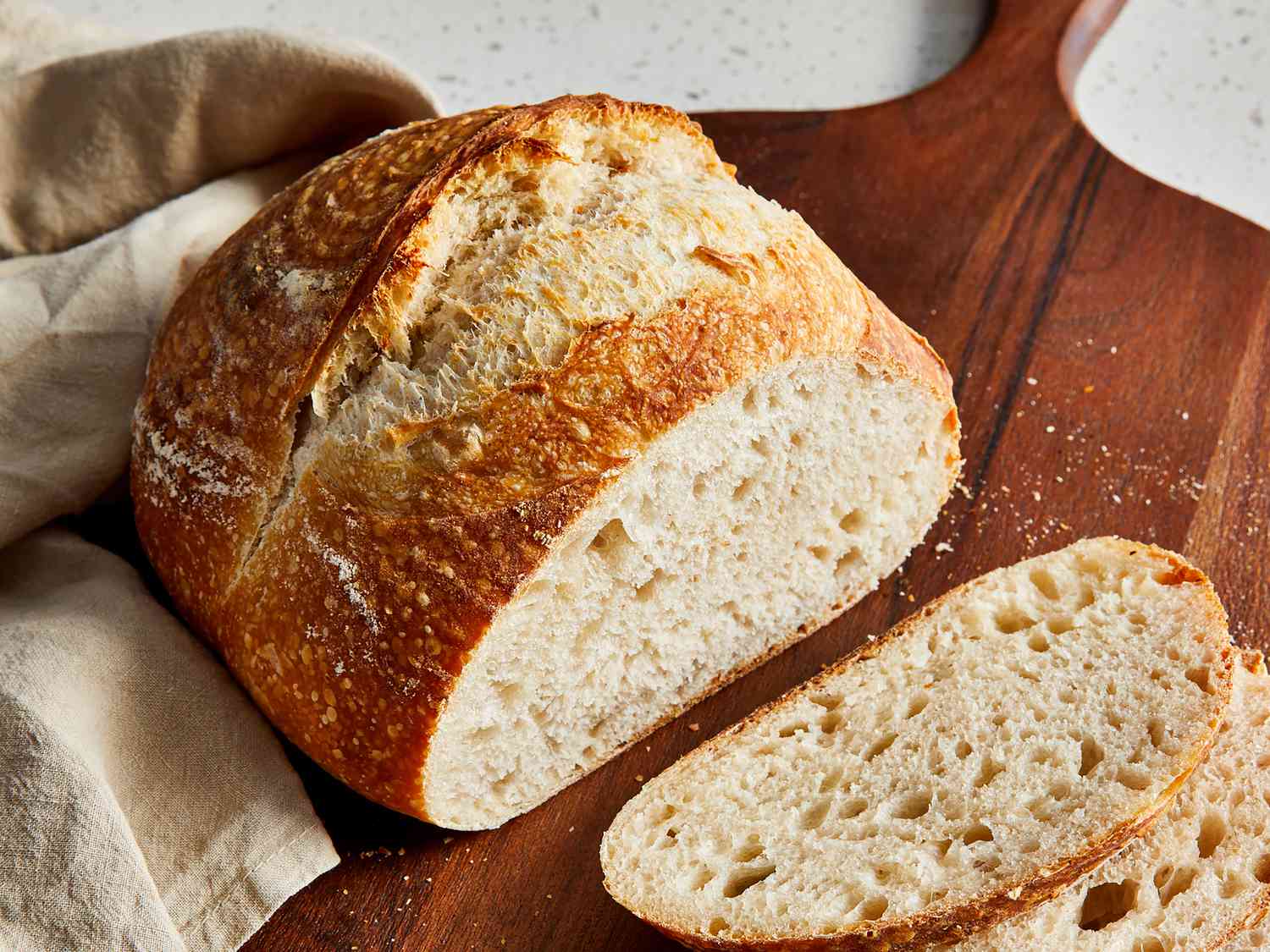
- Remove from the oven and let cool on a cooling rack for 1 hour.